High Pass Image Filter
A multi-threaded image sharpening tool that compares the performance of C++ and hand-written x64 Assembly implementations of the same convolution filter.
Gallery
About This Project
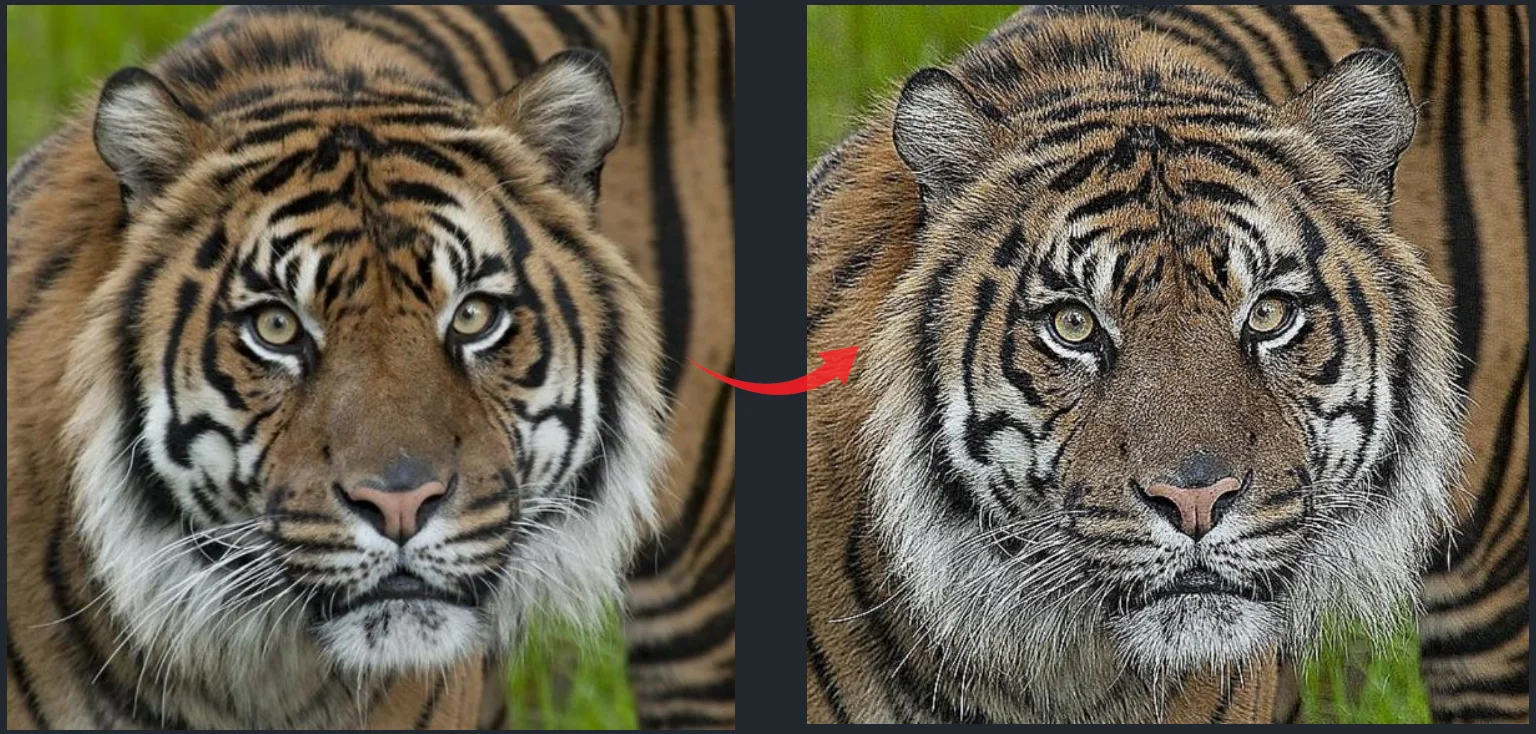
HighPassImageFilter is a Windows console application that applies a 3×3 high-pass convolution kernel ([-1,-1,-1 / -1,9,-1 / -1,-1,-1]) to bitmap images using two interchangeable native DLL backends: one in C++ and one in x64 MASM Assembly. The tool exists to quantify the performance difference between a compiler-optimised implementation and a manually SIMD-optimised one across a configurable number of parallel threads.
Benchmarking mode runs both implementations across seven thread counts (1, 2, 4, 8, 16, 32, 64) for a user-specified sample count and prints average execution time with standard deviation for each configuration. University project, semester 5, 2022/2023.
Features
- Two DLL backends — C++ (
ExecuteInCpp) and x64 MASM Assembly (ExecuteInAssembly) export the same C ABI - Configurable parallelism — row-based thread decomposition across 1–64 threads
- Benchmark harness — 7 thread counts × N samples, trims first 2.5% to remove JIT warm-up, reports mean ± std dev
- Strategy pattern —
Algorithmabstract base +CppAlgorithm/AsmAlgorithmsubclasses;ThreadsManageris algorithm-agnostic - Bulk bitmap I/O —
CustomBitmapusesLockBits/Marshal.Copyto avoid per-pixelGetPixel/SetPixelGDI+ overhead
Technical Architecture
Three Visual Studio projects in one solution: JA_Projekt (.NET 6.0 C# host — orchestration, UI, benchmarking), CPP (C++ DLL), ASM (MASM DLL). The C# host loads a bitmap into a flat byte[], partitions the row range across N worker threads via TPL Task, and dispatches each to the selected DLL for its assigned rows. The DLL writes directly into a pre-allocated output buffer.
CalculateThreadsValues computes realHeight = height - 2 and realWidth = stride - 2*pixelStride to exclude border pixels that lack a complete 3×3 neighbourhood. CalculateStartingIndex constructs the precise byte offset for each thread-row combination, accounting for GDI+ stride padding.
Engineering Highlights
SIMD horizontal sum via psadbw — Because all eight neighbour coefficients are -1, the dot product reduces to 9 × center − sum(8 neighbours). The Assembly implementation packs 8 surrounding bytes into the lower half of XMM1 via pinsrb, then uses psadbw against a zeroed XMM2 as a horizontal byte sum (since |v - 0| = v for unsigned bytes). Center pixel is loaded separately, multiplied by 9, and the neighbour sum subtracted — computing the full convolution in one SIMD instruction for the accumulation step.
Branchless clamping — cmovg eax, ebx (ebx=255) and cmovl eax, ebx (ebx=0) clamp the result to [0,255] without branch instructions, avoiding pipeline flush costs on the per-pixel hot path where saturation is frequent in high-contrast regions.
Benchmark warm-up trimming — RemoveFaultyMeasurements(floor(N × 0.025)) discards the first 2.5% of samples before computing statistics, eliminating JIT compilation and CPU cache cold-start bias. Standard deviation uses the population formula via LINQ: sqrt(average(pow(v - mean, 2))).