Lethal Speed
A fast-paced parkour action game where movement mastery and split-second sword combat decide how quickly you can clear three distinct levels.
Gallery
About This Game
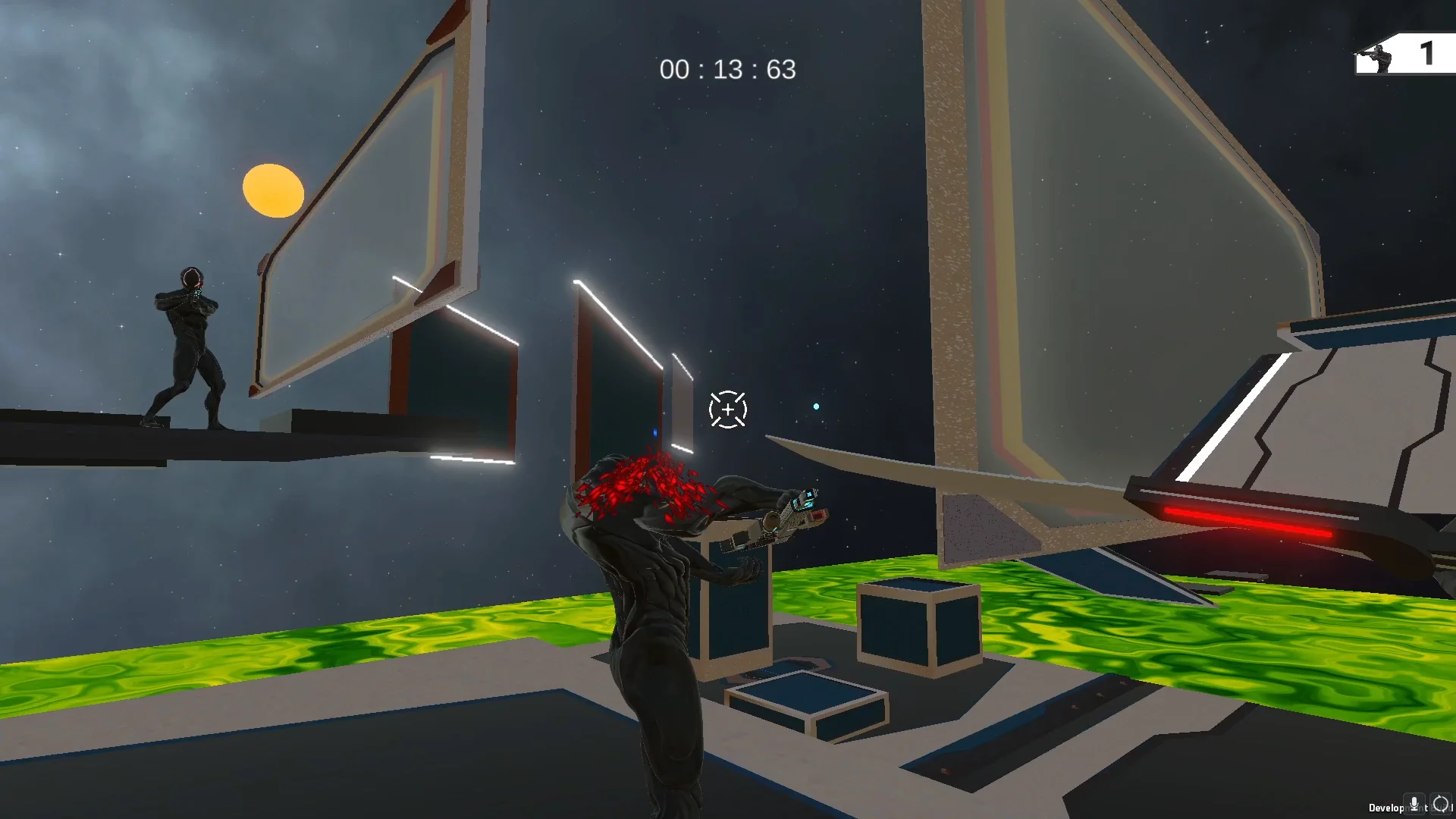
LethalSpeed is a Unity first-person speedrunning game built around a deep parkour movement system and sword-based combat. Players select one of three levels and eliminate all enemies as fast as possible using an extensive movement toolkit: sprinting, crouching, sliding, wall-running, dashing, grapple-hook launching, and spring-joint rope swinging. A persistent timer records best completion times per level.
The combat system is deliberately constrained to a single melee sword attack — creating constant tension to close distance quickly before taking gunfire. Death triggers a brief slow-motion effect. As Project Manager of the 6-person team, I was responsible for the movement system architecture, enemy AI, weapon implementation, and core gameplay systems.
Features
- Eleven movement states — each an independent C# class; the main loop contains no switch statements, all branching delegated to the current state object
- Seven-point vision system — enemy raycasts to center, head, feet, and four side points with a voting rule for correct partial-occlusion detection
- Procedural rope visualization — scalar spring-damper drives wave amplitude; sine + cosine on perpendicular axes with 90° phase offset produces a 3D helical wave
- Persistent leaderboard — best times serialized to JSON (AES-256 encrypted options) via
IDataService/JsonDataService - CI/CD pipeline — GitHub Actions + Game-CI runs PlayMode and EditMode tests before Windows 64-bit builds; Library folder cached between runs
Technical Architecture
Player movement: PlayerMovement delegates Update/Move/Begin/End to the current MovementState. Eleven states (Running, Air, Crouching, Sliding, Dashing, Wallrunning, Grappling, Swinging, LedgeClimbing, Death, Idle-equivalent) are plain C# classes receiving the context as a parameter. Transitions happen inside each state’s CheckForModeChange, keeping transition logic localized to the state that knows when to exit.
Enemy AI: StateMachineEnemyAI delegates UpdateState via nine states created by StateFactoryEnemyAI. VisionEnemyAI, LocomotionEnemyAI (NavMesh), and WeaponEnemyAI are composed rather than inherited. Emotional transitions (flee/engage) are gated by a global cooldown timer plus per-encounter boolean flags, preventing oscillation jitter without hysteresis logic.
Persistent systems: SystemsBootstrapper uses RuntimeInitializeOnLoadMethod(BeforeSceneLoad) to instantiate Addressable prefabs before any gameplay scene’s Awake runs, eliminating scene-load-order dependency problems.
Engineering Highlights
Wall-tangent direction at runtime — Vector3.Cross(wallNormal, Vector3.up) gives the unsigned horizontal tangent. Sign disambiguation: compare (orientation.forward - forwardDir).magnitude vs. (orientation.forward + forwardDir).magnitude and pick the smaller distance. Works at any wall angle without storing left/right wall flags.
Tiered speed clipping — Large overshoots (>1 m/s above cap) decay gradually via time-scaled deceleration preserving momentum feel; small overshoots snap immediately to cap. _initialSpeed at wall-run start is tracked separately from CurrentMaxSpeed, allowing players to carry momentum from a pre-wall-run dash through the wall phase — rewarding movement chaining.
Multi-point occluded vision — Seven body-part positions derived from player position and live scale (playerHeight * localScale.y correctly repositions top/bottom during crouch). Voting rule: any core part (center, top, bottom) unoccluded OR ≥2 side points simultaneously unoccluded. Prevents wall-hidden detection while correctly handling partial-exposure cases.