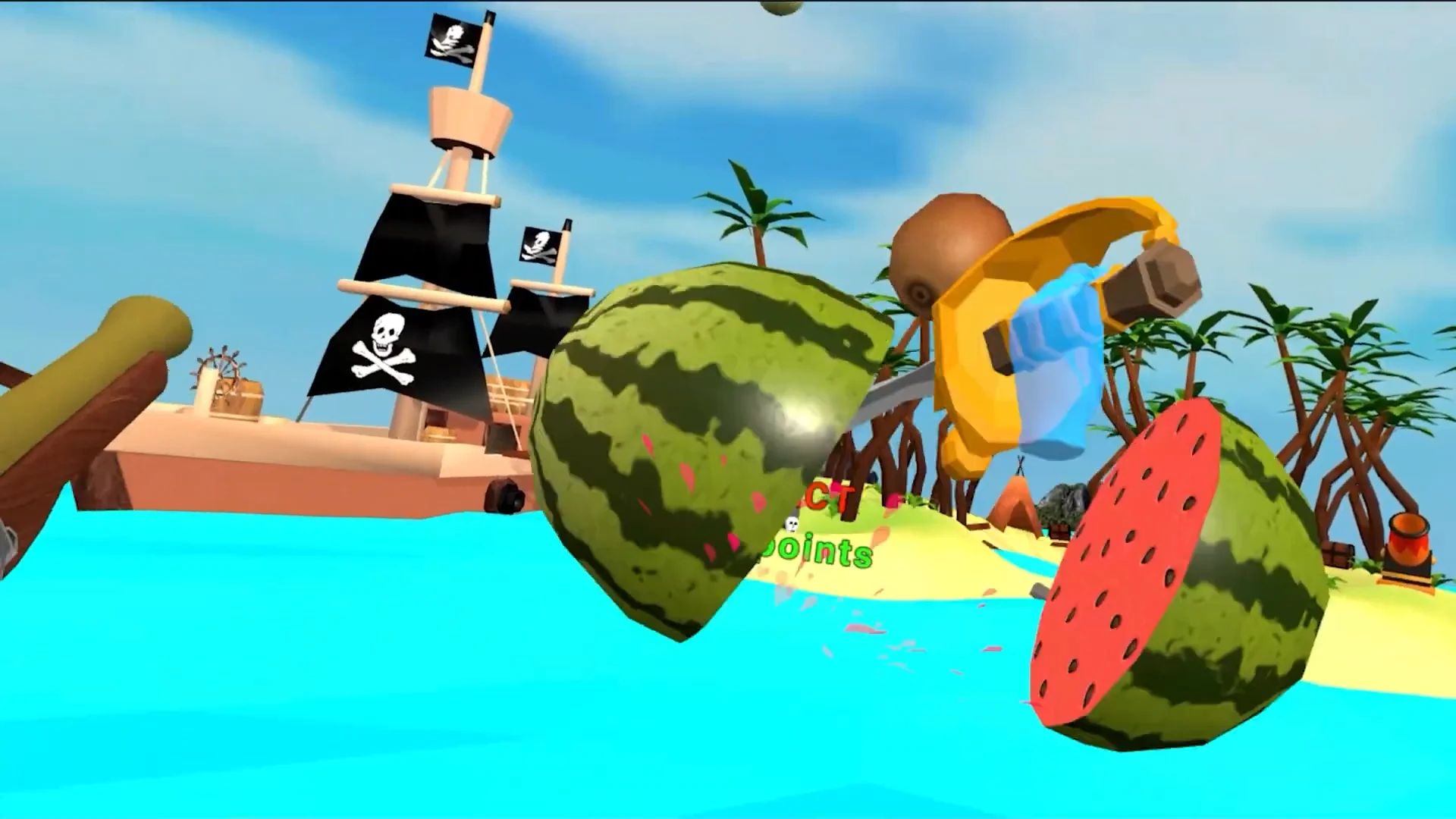
Pirate Rush VR
A VR rhythm-action game for Oculus Quest 2 where players slice flying fruit and shoot barrels as a pirate, submitted as an engineering thesis.
About This Game
PirateRushVR is a standalone VR arcade game for Oculus Quest 2, developed as an undergraduate engineering thesis. Players wield a sabre to slice inbound fruit projectiles and a flintlock pistol to shoot barrels, earning score multipliers for clean play while dodging bombs fired by surrounding cannon towers.
Before each session, players enter a nickname via an in-VR keyboard and choose a difficulty level. Scores persist to a local leaderboard, and a real-time in-game display tracks the current run against the personal best. Comfort options include adjustable volume, snap/smooth turning, and a comfort mode to reduce simulator sickness. The game ships as a sideloaded APK installed via ADB.
Features
- Dual-weapon gameplay — slice fruit with a sabre, shoot barrels with a flintlock pistol; wrong weapon on wrong target deducts score
- Perfect slice bonus — awards extra points when the cut passes near the center of the mesh, evaluated via exact volume computation
- Difficulty system — Easy / Medium / Hard via
DifficultySOScriptableObjects; all spawn rates, timing, and tolerances are inspector-configurable - Persistent leaderboard — scores serialized to JSON on device, compared in real time during gameplay
- Slow-motion freeze — special projectiles trigger a time-scale effect using
unscaledDeltaTimeso UI and input remain responsive
Technical Architecture
The project is structured around manager singletons (GameManager, CannonsManager, ScoreManager, HealthManager, AudioManager, SlowMotionManager) using a two-level StaticInstance<T> / Singleton<T> MonoBehaviour hierarchy. A SystemBootstrapper runs via [RuntimeInitializeOnLoadMethod(BeforeSceneLoad)] and uses Addressables to instantiate a PersistentSystems prefab before the first scene loads, avoiding DontDestroyOnLoad clutter.
Cannon towers drive projectile spawning through a custom TickEngine at 32 Hz, decoupled from the rendering frame rate. The combo system uses a Queue<ICannonBehavior> of Command objects — CannonSpawnBehavior and CannonWaitBehavior — created by a ComboItemFactory. Named combo sequences are loaded from ComboDatabase ScriptableObjects via Addressables labels; when the queue drains, a probability roll decides between replaying a named combo and generating a fresh procedural one from DifficultySO weights.
The weapon system is built on an abstract Weapon base class. Sabre performs Linecast-based hit detection and invokes EzySlice to cut the target mesh into two hulls. Pistol fires a Bullet prefab on the XR trigger action. Projectile effects (damage, healing, freeze) are ScriptableObject chains on each ProjectileSO, applied at hit time via Projectile.ApplyEffects — composing multi-effect projectiles from the inspector without code changes.
Engineering Highlights
Perfect slice detection via signed mesh volume — Judging whether a cut passed near the center of a non-uniform mesh cannot use bounding boxes. Instead, CalculateVolume applies the divergence theorem: each surface triangle forms a signed tetrahedron with the origin, and summing (v1 × v2) · v3 / 6 over all triangles gives exact mesh volume. After EzySlice produces both hulls, IsSlicePerfect checks whether each hull’s volume ratio falls within [0.5 ± tolerance], where perfectSliceTolerance comes from DifficultySO.
Ballistic trajectory with configurable apex height — Cannon towers derive launch velocity analytically from kinematics: v_y = sqrt(-2 * g * h) for a desired apex h, total flight time sqrt(-2h/g) + sqrt(2*(dy-h)/g), horizontal velocity = XZ displacement ÷ flight time. Because gravity is sampled from a per-shot Interval<float>, each projectile follows a visually distinct arc while aiming remains accurate.
Tick-rate-independent combo timing — The TickEngine fires UpdateOnTick at 32 Hz regardless of GPU frame rate, which matters on the Quest 2’s variable-refresh-rate display. ComboItemFactory.CalculateTicks converts authored durations (e.g., 750 ms) into tick counts at the current tick rate, so rebalancing difficulty never requires changing timing constants in code.