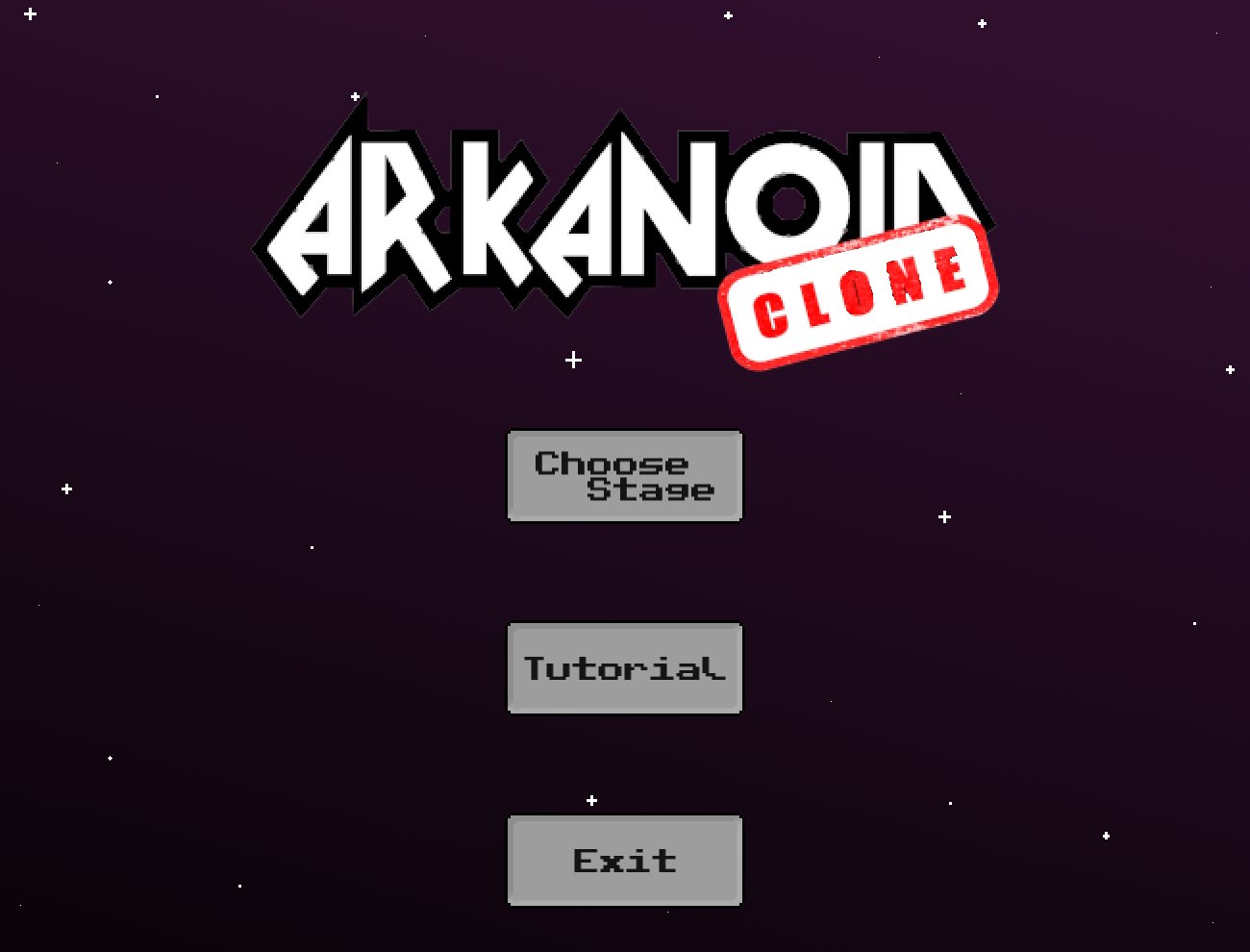
Arkanoid Game Clone
A faithful C++ recreation of the 1986 Taito arcade classic, complete with all 33 original levels and a boss fight.
Gallery
About This Project
ArkanoidGameClone is a feature-complete reproduction of Arkanoid, the 1986 Taito arcade game, built in C++17 with SFML. It includes all 33 original stages loaded from external text-format map files, four brick types, three power-ups, and a dedicated boss encounter. A main menu, level selector with stage previews, tutorial screen, and high-score tracking round out the feature set.
Features
- All 33 original stages — loaded from flat 325-character text files validated at runtime by
std::regex - Segmented Vaus paddle — seven independently collidable parts (
BluePart,RedPart,GreyPart,CentralPart) each return a distinct reflection vector, reproducing zone-based angle steering - Four brick types — colour bricks, silver bricks (HP scales with stage:
2 + stageNumber/8), gold bricks, and the 64-HP boss brick worth 10,000,000 points - Three power-ups — health restore, ball-split, and slow-down via a two-stage random roll with overlap prevention
- Template resource manager — single
Resource<T>handles textures, fonts, and sound buffers withO(1)cache and filesystem auto-discovery
Technical Architecture
SceneManager owns the active Scene and dispatches Update/draw each frame. Concrete scenes (MenuScene, TutorialScene, LevelSelectorScene, GameScene) inherit from abstract Scene and manage their own logic in isolation.
Entities inherit from abstract EntityRectangle / EntityCircle base classes. Bricks implement IBrick. The Vaus paddle decomposes into seven IVausPart subclass instances each with a hardcoded GetReflectionVector().
Engineering Highlights
AABB penetration-depth collision — Overlap rectangle from FloatRect::intersects → minimum dimension identifies the struck face → ball displaced outward by penetration depth → standard reflection formula r = d - 2(d·n)n applied. Without the displacement step, the reflected ball re-triggers on the next frame and oscillates. The same two free functions (CalculateCorrectionVector, ReflectedVector) handle both brick and paddle collisions.
Text-file stage format with regex validation — Each stage is a flat 325-character grid of single-character brick codes. Stage runs std::regex against the full file before constructing any objects, failing fast on malformed input rather than silently producing corrupt layouts or undefined behavior from an unchecked switch fall-through.
Template lazy-loading resource cache — Resource<T> stores shared_ptr<ResourceType> in unordered_map, walks the asset tree with std::filesystem::recursive_directory_iterator on first access, and returns raw non-owning pointers thereafter. The ResourceManager singleton wraps three typed Resource<T> instances, eliminating duplicated loading logic across all SFML asset types.