CardsEstateQuest
Two-player strategy game adapted from a card game.
Gallery
About
CardsEstateQuest is a digital adaptation of Gra w Osiedle, a physical card game created by the URBANMODEL student group at the Faculty of Architecture of the Silesian University of Technology.
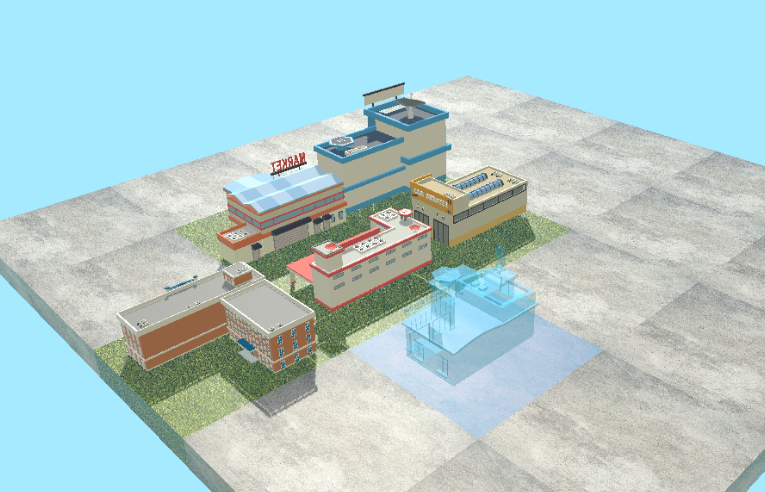
Two players compete across three rounds, taking opposing roles: Developer or Ecologist. They place building cards on a shared grid. The Developer scores based on building intensity, while the Ecologist scores based on biologically active area. The neighbor-averaging mechanic makes placement position as important as card choice.
Players enter a nickname, choose difficulty, and play a best-of-three match. Scores are compared in real time against configurable parameter goals.
Technical Architecture
The game loop uses the State pattern. RoundManager delegates round behavior to the current IRoundState.
The round flow is split into four plain C# state classes:
RoundPreparationStateRoundPlayStateRoundEndStateGameEndState
Each class handles one phase. Transitions use explicit TransitionTo() calls, keeping phases isolated.
Cards and difficulties are stored as ScriptableObjects and loaded at runtime with Unity Addressables, keeping asset references out of scene hierarchies.
The grid generates an N × M layout at runtime. GridItem handles hover and click interactions through OnMouse* callbacks, manages ghost preview rendering, and runs neighbor-aware parameter scoring on placement.
Tooltip Positioning
The tooltip uses a quadrant-aware pivot instead of a fixed offset with clamping.
Its RectTransform.pivot is updated each frame based on the cursor screen quadrant:
pivot.x = 1in the right half, so the tooltip grows leftward.pivot.x = 0in the left half, so the tooltip grows rightward.
A threshold nudge adds clearance from the cursor hotspot.