Chess In Terminal
A fully playable two-player chess game that runs entirely in the terminal, with FEN position loading and PGN game export.
Gallery
About This Project
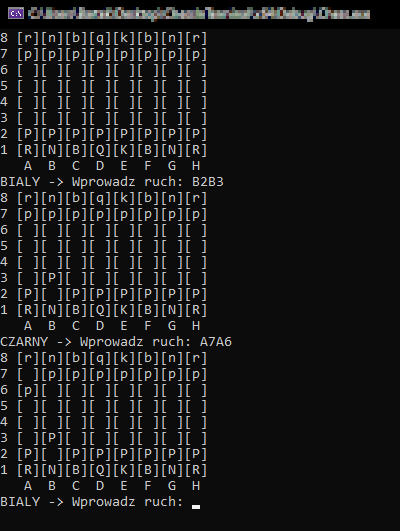
ChessInTerminal is a command-line chess application written in C++ implementing complete chess rules for local two-player games. The board renders as an ASCII grid with piece symbols in brackets ([K], [p], [ ]). Players enter moves using long algebraic notation (e2e4) or query legal moves for a piece by typing its square coordinate.
The game detects check, announces it before each prompt, and saves the full move list to a file on checkmate. It supports command-line arguments (-i for input file, -o for output file), and loads starting positions from FEN notation — making it fully scriptable.
Features
- Complete chess rules — all standard piece movements, check detection, and checkmate
- FEN support — load arbitrary positions from a text file; defaults to standard starting position
- PGN-compatible export — move history written in numbered long-algebraic notation, importable into most chess viewers
- Legal move query — type a square coordinate to display all legal moves for that piece
- Scriptable —
-i/-oflags for input/output file paths
Technical Architecture
Five core abstractions power the engine:
Piece(abstract base class) — pure virtualValidMoves()returnsvector<vector<Coords>>where each inner vector is a directional ray. Sliding pieces emit rays of up to seven squares; non-sliding pieces emit single-element rays. The move generator breaks out of a ray on the first blocker, naturally modelling occlusion without per-piece logic.Square— holds a nullableshared_ptr<Piece>(nullptr= empty). Piece transfers on move are pointer reassignments.Board— ownsSquare[8][8], exposes query and mutation methods, implements FEN parsing, and providesoperator<<for rendering.Move— dual-mode: withonlyKingAttack=falseit builds pseudo-legal moves; withtrueit only setsenemyKingUnderAttack, reusing the same movement geometry for check detection without a separate attack map.GameManager— game loop, input validation, check/checkmate detection, turn swap, output.
Key Engineering Decisions
Board copy for simulation — isCheckNextNextRound accepts Board by value. Copying the board copies all 64 shared_ptr members; SimulatedMovePiece reassigns pointers on the copy, leaving the original untouched. This gives correct independent simulation state without a custom copy constructor.
pawnMultiplier (+1 / -1) — collapses white and black pawn direction into a single code path.
Check detection via move generator reuse — AttackEnemyKing calls GeneratePseudoLegal with onlyKingAttack=true, skipping all move collection but still evaluating reachability. Avoids maintaining a separate attack bitboard at the cost of iterating all enemy pieces per check query.
Lessons Learned
The two-phase legal move generation approach (pseudo-legal → simulation filter) requires careful separation of board mutation from querying — the simulated board must be a true independent copy. C++ value semantics with shared_ptr provide this naturally, though the correctness is non-obvious at first glance.
The vector<vector<Coords>> ray structure is effective for communicating blocking semantics to the generator but creates an implicit contract not enforced by the type system. A future iteration might pass Board const& to ValidMoves() to allow pieces to handle their own board-context special cases, eliminating the Pawn::ValidMoves() returning an empty vector.